Tuesday, November 24, 2026
Netflix Dolby Vision: What the $7 Extra Buys
- Published
- 5:40 PM
- Author
- Comments
- 0
Netflix will not sell you Dolby Vision by name. Its plans page lists Premium as "Watch in 4K (Ultra HD) + HDR", and the word HDR hides which format your TV gets. As of November 2026, the household paying $7 a month more than Standard learns the answer in the living room. Netflix Dolby Vision turns up only when the TV, port, cable and app setting all agree.
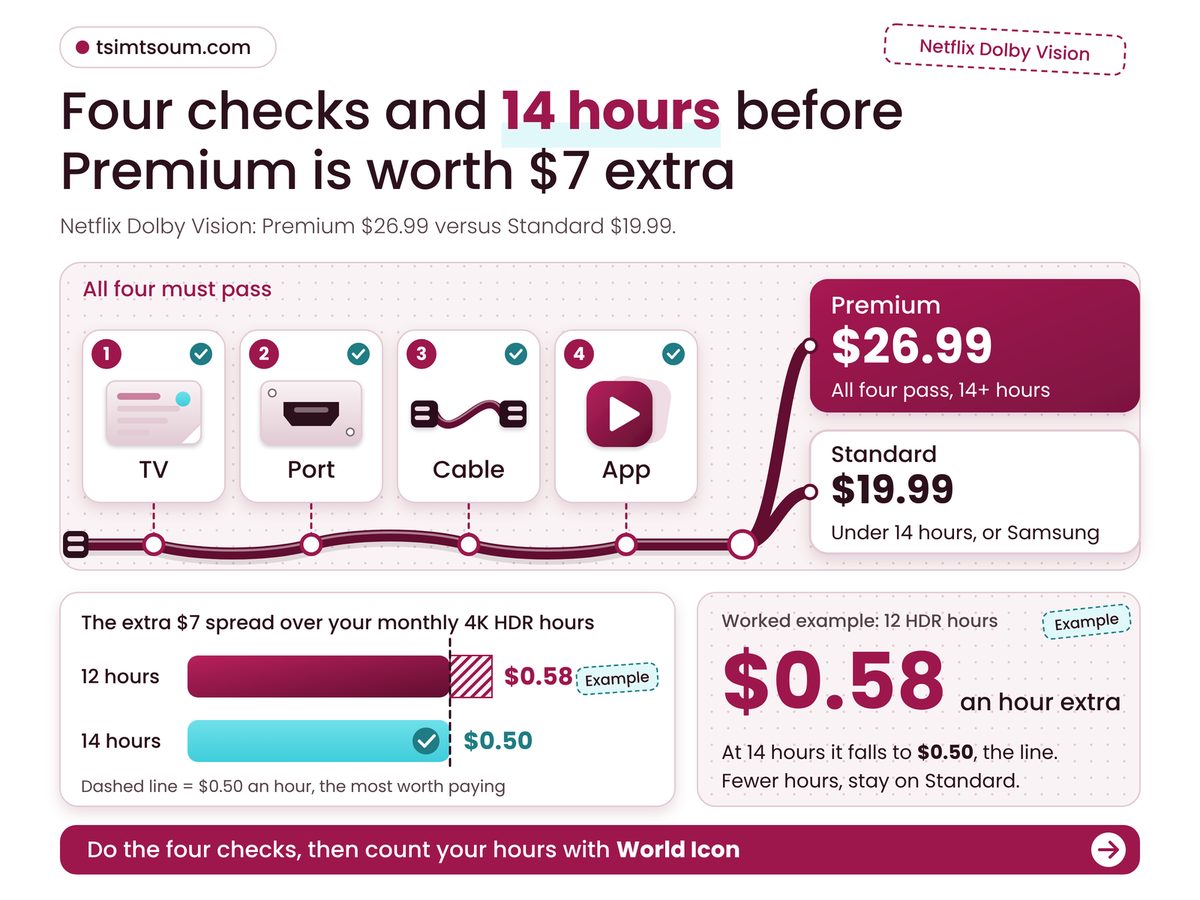
Pay the extra $7 for Premium only if your whole chain passes and you watch 14 or more hours a month of 4K HDR titles.
- Netflix names HDR, never Dolby Vision or HDR10+, so your TV box badge decides the format.
- Any weak TV, port, cable or app setting caps the picture, and the bill stays the same.
- Under 14 hours, or a Samsung set (no Dolby Vision, per What Hi-Fi in 2025), means Standard is the better buy.
What does Netflix Dolby Vision cost you each month?
It costs $7 a month more than Standard, or $18 more than the ads tier, because Netflix's plans page lists HDR only against Premium at $26.99, as of 24 November 2026.
Standard says "Watch in 1080p (Full HD)" and lists no HDR. Dolby Vision, HDR10+ and Dolby Atmos appear nowhere. That is a category on the bill, not a format.
The help page on video quality fills part of the gap. It defines Dolby Vision as "A high dynamic range (HDR) system developed by Dolby Laboratories". Our reading: only Premium lists HDR, so Dolby Vision sits behind Premium too, and Engadget reported on 16 August 2026 that Netflix requires it.
Then the chain. Netflix says "all the devices you're using have to support that quality", down to an HDMI port with "HDCP 2.2 or later" and Premium-rated cables. If one part falls short, playback drops to what that part can do. The weakest link sets your picture.
Two side costs sit outside the sum. 4K counts against a home data cap (see 4K streaming data usage against a home internet cap), and HDR hours change what the set draws (see TV electricity cost by picture mode and HDR hours).
Four numbers frame the call: one read off Netflix's plans page on 24 November 2026, three our arithmetic on its prices.
Premium Step-Up
$7.00
Over Standard, per month, derived
Screens At Once
4
Premium, against 2 on Standard
Step-Up Share Of Bill
26%
Derived: about one dollar in four
Break-Even Viewing
14 hours
A month, at our 50-cent line
Break-even viewing turns a price into a habit. Count it honestly: Netflix concedes "Most (but not all) Netflix titles are available in HD or 4K," so HDR hours run below TV hours.
Premium does not sell Dolby Vision. It sells permission to receive it, and your TV, port, cable and app each hold a veto.
Which hours make the $7 step-up worth it?
At about 14 hours a month of 4K HDR titles, the step-up from Standard falls to 50 cents an hour, our line; from the ads tier you need about 36 hours.
Find your monthly 4K HDR hours on the left, then read across at your plan. Each cell is the step-up divided by those hours: our arithmetic from Netflix's prices.
| 4K HDR hours a month | Extra per hour from Standard | Extra per hour from ads tier |
|---|---|---|
| 6 hrs | $1.17 | $3.00 |
| 10 hrs | $0.70 | $1.80 |
| 14 hrs | $0.50 | $1.29 |
| 20 hrs | $0.35 | $0.90 |
| 30 hrs | $0.23 | $0.60 |
The tinted cell is our line: 14 hours from Standard costs 50 cents an hour. Four hours fewer lifts it to $0.70; six more drops it to $0.35. The line is our judgment, not a Netflix figure.
Four checks stand between the $7 step-up and a Dolby Vision picture, and the first to fail sets what you watch. The order is ours; the requirements come from Netflix's video quality page, read 24 November 2026.
Worked example: A household on Standard at $19.99 watches 30 hours a month, and 40% of those hours are 4K HDR titles. Those are our assumptions, not Netflix data. That makes 12 hours. Premium at $26.99 costs $7.00 more, so $7.00 over 12 hours is $0.58 per 4K HDR hour. That is above our $0.50 line, so this household stays on Standard. It would need 14 hours, or 47% of its 30. This is the extra-per-hour sum; the calculator below runs it on your numbers.
Why can a Premium bill still play plain HDR?
Because Netflix plays "the highest quality available for that device, port, or cable", a Premium bill buys permission to stream HDR, not a guarantee that your living room can receive it.
Samsung owners meet this first. What Hi-Fi reported on 26 March 2025 that Netflix's HDR10+ needs Premium and an AV1-capable device. Its words: "Samsung is the only major brand that produces TVs that support HDR10+ but not Dolby Vision." So a Samsung household pays $7 for HDR10+, as of that report. Whether it beats plain HDR on your set is our reading to test. One title first. Two, actually: one bright, one dark.
Not every service gates HDR this way. Amazon says, in a March 2026 post updated 10 April 2026, that Prime Video included with Prime carries three HDR formats, Dolby Vision among them. Its 4K tier, Ultra, costs $4.99 a month. Our view: if most evenings are on Prime, the Netflix sum is the smaller decision.
If HDR looks dim once on, our note on Filmmaker Mode looking too dark and the two settings to move covers the fix. If the TV's own app is the weak link, smart TV updates versus a streaming stick shows when a stick is cheaper.
- HDR may be off. Netflix says "Some devices may be set to HDR Off by default"; look under Get Help, then Video.
- Set data usage to High or Auto, which Netflix says 4K needs.
Check these about your own set-up first
- Your bill comes through a carrier or bundle, where Netflix says prices can differ: read your account page.
- You live outside the US: open your country's Plans and Pricing page and redo the gap.
- Two TVs share the account and only one passes: count hours on that TV alone.
Decision: stay on Standard or step up. This week, run the extra-per-hour sum with your own numbers: take $7 from Standard or $18 from ads, and divide by your monthly 4K HDR hours. Step up only at $0.50 or less, with a TV box that names Dolby Vision. First check your port and cable against Netflix's video-quality page and your price on its Plans and Pricing page. The call is wrong outside the US, on a carrier bill, or if an hour of better picture is worth more than 50 cents to you.
How we checked this
We read Netflix's US Plans and Pricing page and its video quality help page on 24 November 2026; neither carries a date. We also read What Hi-Fi's report of 26 March 2025 and Amazon's Prime Video Ultra announcement of 13 March 2026. The worked example assumes a Standard plan, 30 hours a month and 40% in 4K HDR titles. No product was tested hands-on for this article.
Last verified: 24 November 2026. Edited by Ragu, reviewed after publication. Spotted something out of date? Tell us and we will correct it.
No comments
Post a Comment