Showing posts with label Internet. Show all posts

Why India's AI Content Label Rule Still Isn't On Screen

10:54 AM

Scroll your feed for ninety seconds. Count the labels. On a Tuesday afternoon in July you will pass a political clip that sounds like a minister but isn't, a product demo with hands that bend the wrong way, and at least one voice note forwarded four times by someone's uncle. India made labelling all of it compulsory in February. Five months later, almost nothing on your screen carries the tag the law demands.
Why India's AI Content Label Rule Still Isn't On Screen
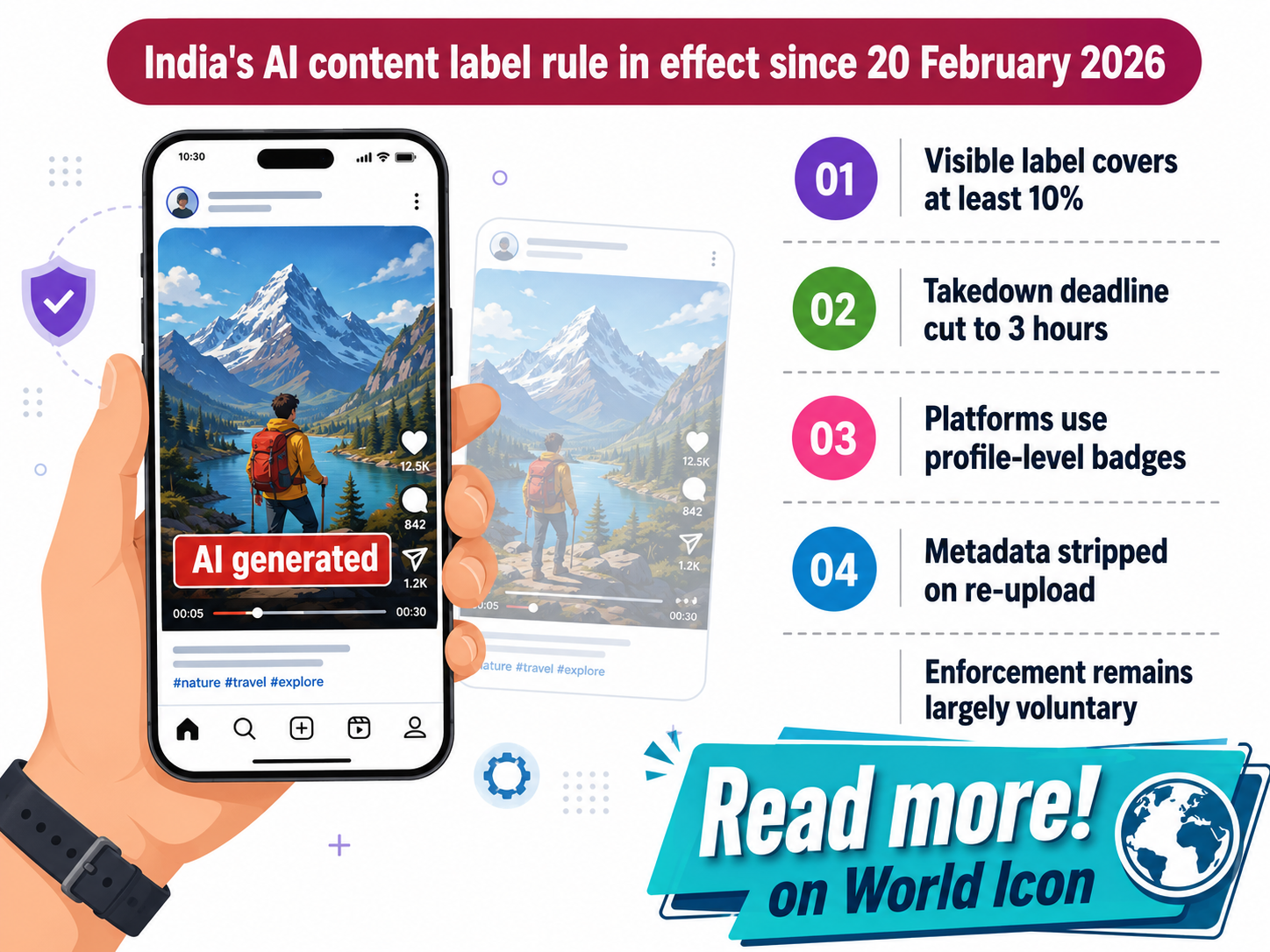
TL;DR: India's AI content label rule has been in force since 20 February 2026, requiring a marker across 10% of any synthetic visual and a three-hour takedown clock. Platforms have largely shipped profile badges instead of the mandated overlay, and enforcement so far looks voluntary.

Why It Matters

The Ministry of Electronics and Information Technology notified the amendments to the Intermediary Guidelines on 10 February 2026 and switched them on ten days later. That is a brutally short runway for a rule that touches every upload pipeline at Meta, Google and X. The core demand is not vague either: synthetically generated information has to carry a visible disclaimer plus permanent provenance metadata, and the marker must occupy at least a tenth of the visual surface or the opening tenth of an audio clip. Written that way, the rule is unusually specific for Indian tech regulation. Someone clearly anticipated the standard dodge of a grey four-point watermark tucked in a corner.

Here is where I part company with most of the commentary. The February coverage treated the three-hour takedown window as the headline and the labelling as a footnote, and that reading is backwards. Takedowns are reactive, complaint-driven, and invisible to you unless you happened to see the thing before it vanished. The label is the only part of this rule that changes what a normal person experiences every single day. It is the difference between a country where synthetic media is quietly deniable and one where it announces itself. Regulators get the sequencing wrong constantly, and this is a case where they actually got it right and then the coverage flattened it.

And the gap between what a spec promises and what ships is not new territory for anyone who reads this site. We made the same argument about broadcasters selling pixel counts while quietly starving live sports of frames, in a piece on why frame rates matter more than 4K. The pattern repeats because the incentive repeats: a company will always prefer the compliance gesture that photographs well over the one that costs engineering hours. Provenance metadata that survives a re-upload, a screenshot, and a WhatsApp compression pass is genuinely hard. A badge on a profile page is a weekend of work. Guess which one arrived first.

The numbers underneath the rule explain why the government moved this fast, and they are worth sitting with before anyone dismisses the mandate as regulatory theatre.

Takedown Clock
3 Hours
Cut from thirty-six
Compliance Window
10 Days
Notified to in force
Complaint Volume
80,000
Cybercrime cases, women, 2026
Label Floor
10%
Minimum visual surface area

That complaint figure is the one that reframes the whole debate. Cybercrime complaints involving women in India rose from roughly 50,000 in 2024 to nearly 80,000 by 2026, and synthetic imagery is a growing share of that caseload. This was never really a policy about mislabelled marketing videos. It was written for a harm that lands on named individuals, and the ten-day runway starts to look less like arrogance and more like a government that had run out of patience. Whether a visible tenth-of-the-frame marker actually stops that harm is a separate question, and an open one. It does not stop a clip circulating in a closed group where nobody was going to check anyway.

Software that mediates something personal tends to get judged on the promise rather than the delivery, which is roughly the trap we described with AI meditation apps and their claim to blend ancient practice with modern science. Same shape here. The mandate is sound. The shipping record is not.

What The Rule Demands Against What Platforms Shipped

Put the statutory text beside the actual product behaviour and the divergence stops being a matter of opinion. The left column is what the amended Rules require. The right column is what an ordinary user in Chennai or Lucknow can currently see with their own eyes.

DimensionWhat The Rules RequireWhat Shipped By July 2026
Marker sizeAt least 10% of visual surfaceSmall corner tags, well under the floor
Audio disclosureOpening 10% of clip durationRarely applied to forwarded voice notes
Provenance metadataPermanent, must survive redistributionStripped by re-upload and compression
Who gets flaggedThe content item itselfInstagram tags the creator's profile instead
Takedown responseThree hours from official noticeUneven, with documented misses
Enforcement to dateSafe harbour loss under Section 79No major public penalty yet observed
Advertising creativeSame disclosure standard appliesGoogle began permitting in-creative labels in July
Best Suited ForVictims seeking a legal hookPlatforms seeking a defensible paper trail

Read the right column as a sequence rather than a list and the strategy becomes obvious. Every shipped feature is real, documented, and announceable. Not one of them is the tenth-of-the-frame overlay the text actually asks for. The timeline below tracks how the gap opened.

10 Feb 20 Feb 4 May Jun 2026 Rules notified by MeitY Amendments take effect Instagram ships creator badge Enforcement gaps documented publicly

Four months separated the rule taking effect from the first widely reported audit of how little had changed on the platforms it governs.

Friction Points

MediaNama published a June 2026 review compiling ten separate instances where synthetic material kept circulating on major platforms without any marker at all, months after compliance was mandatory. That is the clearest public signal available on how the AI content label regime is actually performing, and it is not encouraging. The rules exist, the technical standard exists, and the behaviour has not shifted much. Regulation without a visible first penalty tends to be treated by large platforms as a budget line rather than a constraint, and nothing yet suggests this case is different.

The honest grey area sits in the definition itself. Almost every image on your phone has been touched by a model at some point: computational photography, noise reduction, generative fill on a stray tourist in the background. Where does enhancement end and synthetic generation begin? Nobody has drawn that line in a way that survives contact with a modern camera app, and until somebody does, an overbroad reading would put a label on essentially every photograph, while a narrow reading lets a fabricated political clip claim it was merely retouched. That ambiguity is not a drafting oversight anyone can patch. It is a real conceptual problem, and I do not think the answer is obvious.

There is also the redressal question, which anyone who has tried to escalate anything to a large Indian service provider will recognise instantly. Filing is easy. Being heard is not, as we found the hard way documenting an Airtel recharge and customer support failure that consumed weeks and produced nothing. A three-hour clock only starts when a valid notice lands, and the machinery for lodging one is the same grievance apparatus that already struggles with billing disputes.

  • Treat an absent label as meaningless, not as proof of authenticity. Compliance is patchy enough that the lack of a marker tells you nothing either way.
  • Check for provenance metadata before you trust an unlabelled file, and assume it is gone if the item reached you through a messaging app.
  • A profile-level creator badge is not the same thing as a per-item disclosure, whatever a platform's press release implies.
  • Screenshot and record the URL before reporting anything, because a three-hour removal also removes your evidence.
  • Be sceptical of forwarded audio in particular. Voice is the cheapest thing to synthesise and the least likely to arrive tagged.

And if the spec sheet itself is the thing being marketed to you, apply the same discipline you would when buying hardware. We argued recently that battery chemistry deserves more scrutiny than camera specs for exactly this reason: the number a company puts on the box is chosen for how it markets, not for how it performs.

Key Takeaways Index Card

➤ A pi-labs analysis found 93% of deepfake victims worldwide are women, alongside a roughly 900% rise in non-consensual synthetic content.

➤ An estimated 62% of deepfake abuse cases involving women are never reported at all, so takedown counts understate the problem badly.

➤ Bengaluru accounts for close to 30% of India's reported cases, making this a concentrated urban problem before it is a national one.

Stop waiting for the tag to appear. Assume anything emotionally loaded that reaches you through a forward is unverified until you have found the original source yourself, and if you spot synthetic material running unlabelled on a major platform, file the complaint and keep the screenshot. The law is already on the books. What it lacks is anyone visibly using it.

Airtel Recharge and customer support Scam Nightmare

11:26 PM

Let me tell you a story. It’s not about something grand, but something incredibly frustrating. A tale of an accidental mobile recharge with Airtel that spiraled into a black hole of automated replies, fake apologies, and zero real help. Sounds familiar?

If you’ve ever tangled with Airtel’s so-called customer care, you’ll probably nod along furiously. But if you haven’t yet, buckle up—because my experience might just prepare you for the chaos that lurks behind the red and white brand. This is not just a rant. It’s a wake-up call.

Airtel Recharge and customer support Scam Nightmare

The Accidental Recharge: Where It All Went Wrong
We've all been there—tapping through apps quickly, making a payment in haste, only to realize… oops. That’s exactly what happened to me when I recharged my Airtel number with a ₹489 plan. What I didn’t realize was that it overlapped with an already active 84-day plan. The new one had just 77 days and, boom—no option to cancel or reverse.

Here’s where things started to crumble:

  • Airtel’s System Doesn’t Prevent Plan Overlaps: You’d think a tech giant like Airtel would throw a red flag when you’re trying to recharge a number that already has a valid plan. Nope. The system happily accepted the recharge and merged it into oblivion.

  • No Confirmation or Alert Before Recharge: Other apps usually flash a warning when a similar recharge exists. Airtel? Not even a beep. The lack of checks feels less like an oversight and more like a trap.

  • The Infamous Airtel Thanks App Bot: As advised, I ran to the Airtel Thanks App for help. What I encountered was a chatbot with the IQ of a potato. Predefined options. No room for actual issues. I wasn’t looking to change my ringtone—I wanted my ₹489 back.

  • Futile Effort to Raise a Complaint: After jumping through digital hoops, I finally got a complaint number. But guess what? It meant nothing. The bot just closed the loop with a “thanks for contacting” message and no real solution.

The False Hope of Resolution: How Airtel Stonewalled My Complaint
Thinking I’d played by the book, I moved to the next step: raising the concern with Airtel’s appellate authorities. You’d expect this level to have humans, right? Think again.

  • Appellate Authorities Just Redirect to Bots: I emailed [email protected] and [email protected] explaining everything. What I got in return was an automated response directing me back to the same Airtel Thanks App. Talk about a dead-end alley with a flashing neon sign that says “We Don’t Care.”

  • A 24-Hour Wait with Zero Progress: I waited a full day—no callbacks, no follow-ups. Not even a “we’re looking into it.” Just silence. If you’re not screaming into a pillow by now, you haven’t dealt with Airtel.

  • Customer Care That Charges You to Complain: Desperate, I called the customer care line. And what a revelation—Rs. 0.50 per minute to talk to a human being. Really, Airtel? Charging people for help on a service issue caused by your own system?

  • A Promise of 10 Days, Then… Nothing: The rep said the issue would be resolved in 10 days. No ticket updates. No texts. Just radio silence. And after the 10-day mark? You guessed it. Still nothing.

Customer Support Theatre: A Scripted Runaround

Still holding onto a sliver of hope, I turned to Airtel’s social media support, thinking maybe this public-facing channel would offer some accountability. Oh, sweet summer child.

  • Airtel’s Twitter/Facebook Support Is Just PR Camouflage:
    They responded, sure. But every message was as canned as a supermarket aisle. “We understand your concern…” “Please note that…” Sound familiar? It’s a rehearsed dance, not support.

  • "Recharge Was Done More Than 3 Days Ago" Excuse:
    The cherry on this garbage sundae was their final reply. Because the recharge was done over 3 days ago, they “couldn’t” do anything. Apparently, Airtel has a magic 72-hour window where your money vaporizes into corporate ether.

  • No Acknowledgment of Overlap or Mistake:
    Not once did anyone from Airtel acknowledge that the plan overlapped or that a customer might accidentally double-recharge. It’s like they were allergic to accountability.

  • Systemic Scams Disguised as Policy:
    This wasn’t just a tech glitch or one bad rep. This was a full-blown, well-oiled machine designed to stall, confuse, and ultimately deny help until you give up. And most people do.

🧠 Quick Comparison Table: Airtel Support Channels

Channel Type Response Time Human Interaction Outcome
Airtel Thanks App Automated Chatbot Instant ❌ No ❌ No resolution
Email (Appellate) Automated Email 12–24 hours ❌ None ❌ Redirect to app
Customer Care Call Paid Call Immediate ✅ Yes (Charged) ❌ No resolution
Social Media Support Scripted Replies 2–4 hours ✅ Minimal (Canned) ❌ Standard denial

Conclusion: A Lesson in Frustration and a Call for Change

At the end of this digital circus, my ₹489 is gone. Airtel got paid. I got nothing—no plan extension, no refund, not even an acknowledgment of the mistake.

But here's the thing: this isn’t just about me. This is about how large corporations treat customers when things go wrong. About how automation, when used irresponsibly, becomes a shield for ignorance. About how support is designed to tire you out, not help.

So if you’re reading this—stay alert. Triple-check your recharges. Demand better. And don’t let telecom giants like Airtel hide behind their bots and broken promises.

Because we deserve better. Period.

Cloud Storage vs. External Drives: What’s Best for You?

10:32 PM

Ever stood in the electronics aisle debating between an external hard drive or a subscription to cloud storage? It’s a modern-day conundrum, especially with our ever-growing digital footprints. Whether you're a student safeguarding your thesis, a professional managing client data, or someone cherishing family photos, the stakes are high.

While external hard drives (HDDs or SSDs) have been a trusted companion for years, cloud storage is emerging as the forward-thinking alternative. So, how do you decide? Let’s dive deep into the pros and cons of each to help you make an informed choice.

External Hard Drives: A Practical Option

External hard drives have long been the go-to storage solution for millions. Here’s why:

  • Affordable and Tangible: You pay once and own the device, making HDDs and SSDs cost-effective for high-capacity storage. With prices as low as $50 for 1TB, it’s a budget-friendly solution.
  • Offline Access: No internet? No problem. External drives offer immediate access to your files without needing a connection, perfect for remote areas or while traveling.
  • Performance Flexibility: SSDs, with their lightning-fast read/write speeds, cater to gamers, video editors, and professionals who need speed and efficiency.
  • Drawbacks to Consider:
    • Durability Risks: Accidents happen—drops, spills, or even theft can render your drive unusable.
    • Tech Obsolescence: Over time, older drives may struggle to keep up with new file systems and compatibility standards.
    • Limited Lifespan: Even the best drives have a limited number of read/write cycles before they fail.

While external drives excel in portability and offline usability, their vulnerability to physical damage and evolving tech standards is a significant downside.

Cloud Storage vs. External Drives: What’s Best for You?

Cloud Storage: The Modern Contender

Cloud storage is no longer just a buzzword—it’s a revolution in how we manage data. But what makes it so compelling?

  • Anywhere, Anytime Access: Whether you're in a coffee shop, on a beach, or in a different time zone, your files are just a login away. With 24/7 access, cloud storage ensures your data is always within reach.
  • Scalable Storage Solutions: Start small with 50GB and scale up to multiple terabytes as your needs grow. Providers like Google Drive, Dropbox, and OneDrive make upgrading seamless.
  • Enhanced Security: Cloud providers invest heavily in encryption, multi-factor authentication, and data redundancy to safeguard your files from hackers and physical disasters.
  • Drawbacks to Weigh:
    • Recurring Costs: Subscription fees can add up—think $10/month for 1TB storage. Over time, this may surpass the cost of external drives.
    • Internet Dependency: No internet, no access. Plus, uploading large files can be tedious on slow connections.
    • Privacy Concerns: Storing sensitive information in the cloud requires trust in your provider’s security measures and policies.

Cloud storage’s adaptability and forward-thinking features make it a robust choice, though its recurring costs and internet reliance may deter some users.

Making the Right Choice: External Drive or Cloud?

Now that we’ve explored the pros and cons, how do you decide? Here’s a detailed comparison to help you make the best choice:

Feature

External Drives

Cloud Storage

Cost

One-time purchase

Recurring subscription

Accessibility

Limited to physical presence

Anywhere with internet

Scalability

Fixed capacity

Flexible and expandable

Durability

Vulnerable to damage

Protected via redundancy

Tech Adaptability

May become obsolete

Continuously updated

Key Considerations:

  1. Budget: If upfront costs are a concern, an external drive may seem appealing. However, for those comfortable with subscriptions, the scalability of cloud storage offers long-term value.
  2. Reliability: Cloud storage eliminates risks like accidental drops, theft, or hardware failure. It's a future-proof solution for safeguarding critical files.
  3. Data Sensitivity: If you’re storing confidential or sensitive data, ensure your cloud provider meets industry compliance standards or consider a hybrid approach.
  4. Hybrid Strategy: Why choose one? Use external drives for large, frequently accessed files and cloud storage for backups and collaborative projects. This way, you get the best of both worlds.

My Final thoughts

When it comes to data storage, there’s no one-size-fits-all answer. External hard drives are practical and budget-friendly but come with risks like damage and obsolescence. On the flip side, cloud storage offers unparalleled convenience and security but requires an ongoing financial commitment.

The choice boils down to your priorities: short-term affordability or long-term reliability. And if you’re still on the fence, a hybrid approach might be your perfect middle ground.

So, what’s it going to be—an external drive you can hold or a cloud you can’t see but can always trust? The future of your files depends on it!

Suggestion for Social Media Marketing

10:03 PM

There are various ways to advertise your product in Internet. You must be sure that your product reaches people. You may have come across different advertising companies in Internet but most of these companies do not help to promote your business. The social media marketing is a new way to market your product, business or a website. The IZEA network is the next generation, innovative social media marketing company. The network aims to empower all customers to value and exchange content, creativity and influence. As this network gets huge support from both advertisers and publishers it is known as a leader in social media marketing

Suggestion for Internet in your neck of the woods

12:39 AM

In recent times Internet has been used for various purposes such as for watching TV, movies, downloading music, social networking and also for various stuff. There are various Internet service providers out there in the market and most Internet service providers lack quality of Internet connectivity and service offered to users. So, make sure that you select best Internet service that offers high speed Internet connectivity and best customer service. The WildBlue is one of the best Internet service available in market that offers high speed Internet connectivity for users even in rural areas and best customer service for users. The WildBlue Internet service offers broadband by satellite connectivity that no other competitor in its class could offer you. If you are planning to buy a high speed satellite internet system in the next few weeks and have been waiting on DSL to deliver high-speed internet to your home or business, then WildBlue Internet service would be the best option. If you are looking to have high speed Internet connectivity even in rural areas for watching TV, social networking, downloading music and movies at an affordable price, then mybluedish.com would be the place you have to check out to get WildBlue Internet service.

Mobile 4G Suggestion

2:40 PM

Are you feeling frustrated of slow dial up Internet connection and looking for solution for Internet speed? Then make sure that you select best Internet service provider available in market. You may have known wide ranges of Internet service providers available in market that provider Internet speed connectivity for consumers. But most Internet service providers and online network lack quality of support and quality high speed Internet connectivity offered to consumers. So, make sure that you select best Internet service provider or network that offers you high speed Internet connectivity for consumers. Recently I came across Interesting network that provides high speed Internet connectivity for consumers known as Clear Wireless Internet. The Clear Wireless Internet is one of the stands alone wimax wireless networks available in market that provides various Internet features for consumers. The mobile 4g Internet connectivity from Clear Wireless Internet network provides various features for consumers that includes speeds are 4x faster than 3G, wireless download speeds average between 3-6 Mbps, wireless internet speeds as fast as you would get with a standard home broadband connection, you can stream live videos, download music, video chat and more with just a click and a lot more Internet stuff included.

Wild Blue Internet service Information

7:47 PM

Are you feeling tired of using slow Internet connection or frustrated of dial-up Internet speed? Then make sure that you select best Internet service available in market. You may have known wide ranges of online networks available in market that offers Internet service for consumers. But most Internet service provider available in market has slow Internet speed connectivity. So, make sure that you select best Internet service provider available in market. Recently I came across Interesting Internet service provider that offers high speed Internet connectivity for consumers known as wildblue.com. The wildblue internet service is one of the high quality Internet service providers available in market that offers high speed Internet connectivity for consumers. In WildBlue satellite internet you will start downloading files at speeds up to 30x faster than dial-up. If you are looking to get high speed Internet connectivity from high quality Internet service provider, then Wild Blue Internet service would be the best option.

WildBlue Satellite Internet Suggestion

5:37 PM

The Internet is the best way to communicate or share ideas among people around the world. If you feel frustrated about your dial-up connection and looking for a solution to your slow Internet speed, then satellite Internet would be the best option. You may have known wide ranges of network available in market that provides satellite Internet service for consumers. But most of them lack high speed connectivity and may not provide coverage in all rural areas. So, make sure that you select high quality satellite internet service provider available in market.

The wildblue is one of the stand alone networks available in market that provides high speed connectivity for consumers. If you are looking to get exciting deals and offers of wild blue Internet service, then wildbluedeals.com would be the best place to check out. The wildblue broadband internet reaches customers in even the most remote locations across the contiguous U.S., and delivers connection speeds up to 30 times faster than dial-up. The WilBlue Internet service provides best customer service and promising support for consumers that no other competitor can offer you. To get best deals and offers of wild blue Internet service, please feel free to check out the wildbluedeals.com website.