Saturday, July 25, 2026
Why India's AI Content Label Rule Still Isn't On Screen
Scroll your feed for ninety seconds. Count the labels. On a Tuesday afternoon in July you will pass a political clip that sounds like a minister but isn't, a product demo with hands that bend the wrong way, and at least one voice note forwarded four times by someone's uncle. India made labelling all of it compulsory in February. Five months later, almost nothing on your screen carries the tag the law demands.
Why It Matters
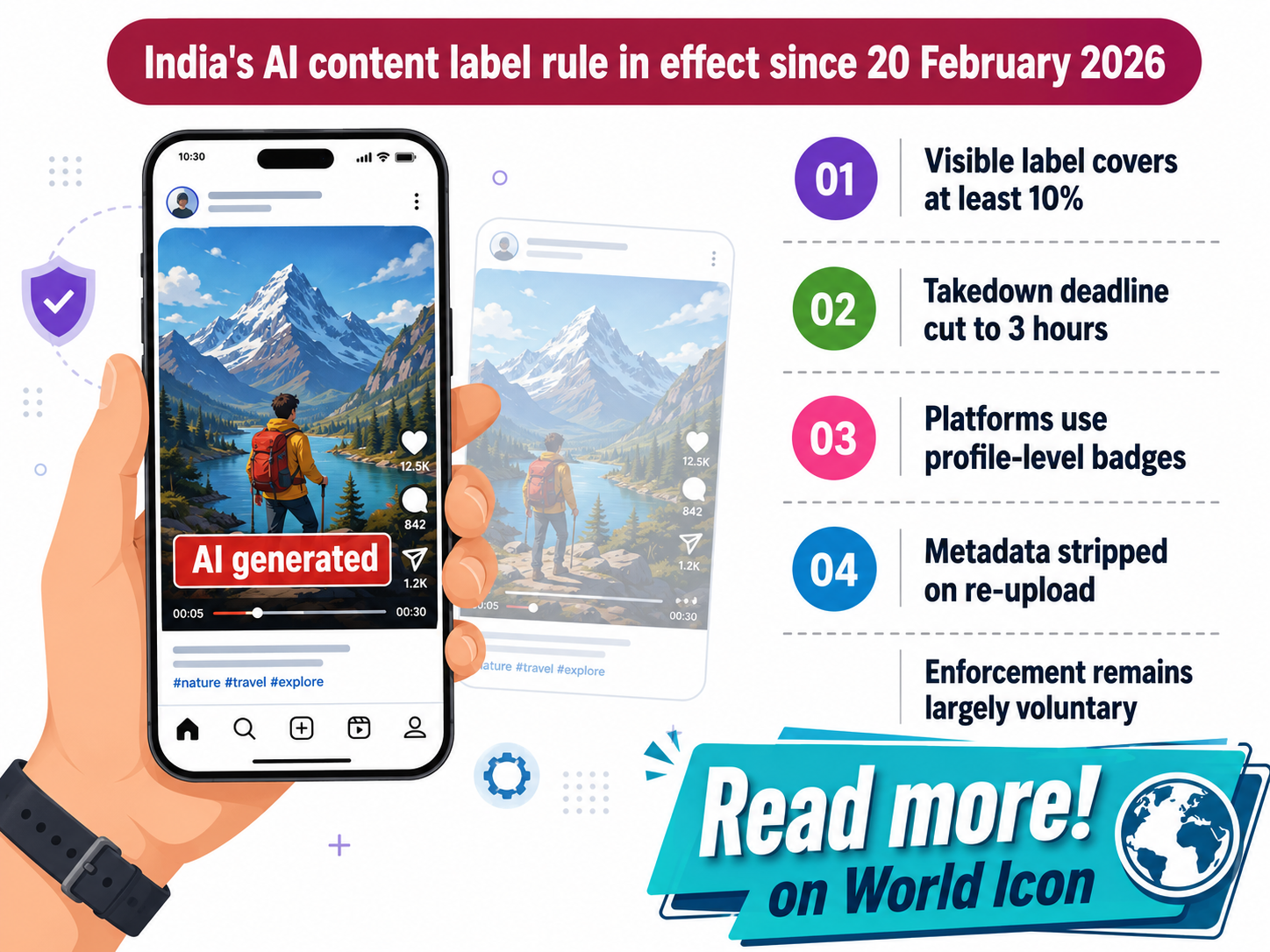
The Ministry of Electronics and Information Technology notified the amendments to the Intermediary Guidelines on 10 February 2026 and switched them on ten days later. That is a brutally short runway for a rule that touches every upload pipeline at Meta, Google and X. The core demand is not vague either: synthetically generated information has to carry a visible disclaimer plus permanent provenance metadata, and the marker must occupy at least a tenth of the visual surface or the opening tenth of an audio clip. Written that way, the rule is unusually specific for Indian tech regulation. Someone clearly anticipated the standard dodge of a grey four-point watermark tucked in a corner.
Here is where I part company with most of the commentary. The February coverage treated the three-hour takedown window as the headline and the labelling as a footnote, and that reading is backwards. Takedowns are reactive, complaint-driven, and invisible to you unless you happened to see the thing before it vanished. The label is the only part of this rule that changes what a normal person experiences every single day. It is the difference between a country where synthetic media is quietly deniable and one where it announces itself. Regulators get the sequencing wrong constantly, and this is a case where they actually got it right and then the coverage flattened it.
And the gap between what a spec promises and what ships is not new territory for anyone who reads this site. We made the same argument about broadcasters selling pixel counts while quietly starving live sports of frames, in a piece on why frame rates matter more than 4K. The pattern repeats because the incentive repeats: a company will always prefer the compliance gesture that photographs well over the one that costs engineering hours. Provenance metadata that survives a re-upload, a screenshot, and a WhatsApp compression pass is genuinely hard. A badge on a profile page is a weekend of work. Guess which one arrived first.
The numbers underneath the rule explain why the government moved this fast, and they are worth sitting with before anyone dismisses the mandate as regulatory theatre.
That complaint figure is the one that reframes the whole debate. Cybercrime complaints involving women in India rose from roughly 50,000 in 2024 to nearly 80,000 by 2026, and synthetic imagery is a growing share of that caseload. This was never really a policy about mislabelled marketing videos. It was written for a harm that lands on named individuals, and the ten-day runway starts to look less like arrogance and more like a government that had run out of patience. Whether a visible tenth-of-the-frame marker actually stops that harm is a separate question, and an open one. It does not stop a clip circulating in a closed group where nobody was going to check anyway.
Software that mediates something personal tends to get judged on the promise rather than the delivery, which is roughly the trap we described with AI meditation apps and their claim to blend ancient practice with modern science. Same shape here. The mandate is sound. The shipping record is not.
What The Rule Demands Against What Platforms Shipped
Put the statutory text beside the actual product behaviour and the divergence stops being a matter of opinion. The left column is what the amended Rules require. The right column is what an ordinary user in Chennai or Lucknow can currently see with their own eyes.
| Dimension | What The Rules Require | What Shipped By July 2026 |
|---|---|---|
| Marker size | At least 10% of visual surface | Small corner tags, well under the floor |
| Audio disclosure | Opening 10% of clip duration | Rarely applied to forwarded voice notes |
| Provenance metadata | Permanent, must survive redistribution | Stripped by re-upload and compression |
| Who gets flagged | The content item itself | Instagram tags the creator's profile instead |
| Takedown response | Three hours from official notice | Uneven, with documented misses |
| Enforcement to date | Safe harbour loss under Section 79 | No major public penalty yet observed |
| Advertising creative | Same disclosure standard applies | Google began permitting in-creative labels in July |
| Best Suited For | Victims seeking a legal hook | Platforms seeking a defensible paper trail |
Read the right column as a sequence rather than a list and the strategy becomes obvious. Every shipped feature is real, documented, and announceable. Not one of them is the tenth-of-the-frame overlay the text actually asks for. The timeline below tracks how the gap opened.
Four months separated the rule taking effect from the first widely reported audit of how little had changed on the platforms it governs.
Friction Points
MediaNama published a June 2026 review compiling ten separate instances where synthetic material kept circulating on major platforms without any marker at all, months after compliance was mandatory. That is the clearest public signal available on how the AI content label regime is actually performing, and it is not encouraging. The rules exist, the technical standard exists, and the behaviour has not shifted much. Regulation without a visible first penalty tends to be treated by large platforms as a budget line rather than a constraint, and nothing yet suggests this case is different.
The honest grey area sits in the definition itself. Almost every image on your phone has been touched by a model at some point: computational photography, noise reduction, generative fill on a stray tourist in the background. Where does enhancement end and synthetic generation begin? Nobody has drawn that line in a way that survives contact with a modern camera app, and until somebody does, an overbroad reading would put a label on essentially every photograph, while a narrow reading lets a fabricated political clip claim it was merely retouched. That ambiguity is not a drafting oversight anyone can patch. It is a real conceptual problem, and I do not think the answer is obvious.
There is also the redressal question, which anyone who has tried to escalate anything to a large Indian service provider will recognise instantly. Filing is easy. Being heard is not, as we found the hard way documenting an Airtel recharge and customer support failure that consumed weeks and produced nothing. A three-hour clock only starts when a valid notice lands, and the machinery for lodging one is the same grievance apparatus that already struggles with billing disputes.
- Treat an absent label as meaningless, not as proof of authenticity. Compliance is patchy enough that the lack of a marker tells you nothing either way.
- Check for provenance metadata before you trust an unlabelled file, and assume it is gone if the item reached you through a messaging app.
- A profile-level creator badge is not the same thing as a per-item disclosure, whatever a platform's press release implies.
- Screenshot and record the URL before reporting anything, because a three-hour removal also removes your evidence.
- Be sceptical of forwarded audio in particular. Voice is the cheapest thing to synthesise and the least likely to arrive tagged.
And if the spec sheet itself is the thing being marketed to you, apply the same discipline you would when buying hardware. We argued recently that battery chemistry deserves more scrutiny than camera specs for exactly this reason: the number a company puts on the box is chosen for how it markets, not for how it performs.
Key Takeaways Index Card
➤ A pi-labs analysis found 93% of deepfake victims worldwide are women, alongside a roughly 900% rise in non-consensual synthetic content.
➤ An estimated 62% of deepfake abuse cases involving women are never reported at all, so takedown counts understate the problem badly.
➤ Bengaluru accounts for close to 30% of India's reported cases, making this a concentrated urban problem before it is a national one.
Stop waiting for the tag to appear. Assume anything emotionally loaded that reaches you through a forward is unverified until you have found the original source yourself, and if you spot synthetic material running unlabelled on a major platform, file the complaint and keep the screenshot. The law is already on the books. What it lacks is anyone visibly using it.
