Tuesday, September 29, 2026
TV Glare: Is a Matte Screen Worth the Trade?
It is a Friday evening and the film opens on a dark tunnel. You lean in, and instead of the tunnel you see the reading lamp behind the sofa, floating in the picture, plus a smeared copy of the sofa itself. That is TV glare, and no spec sheet warned you about it.
Buy a matte screen only if a window or lamp you cannot move shares your sightline for over half your viewing hours.
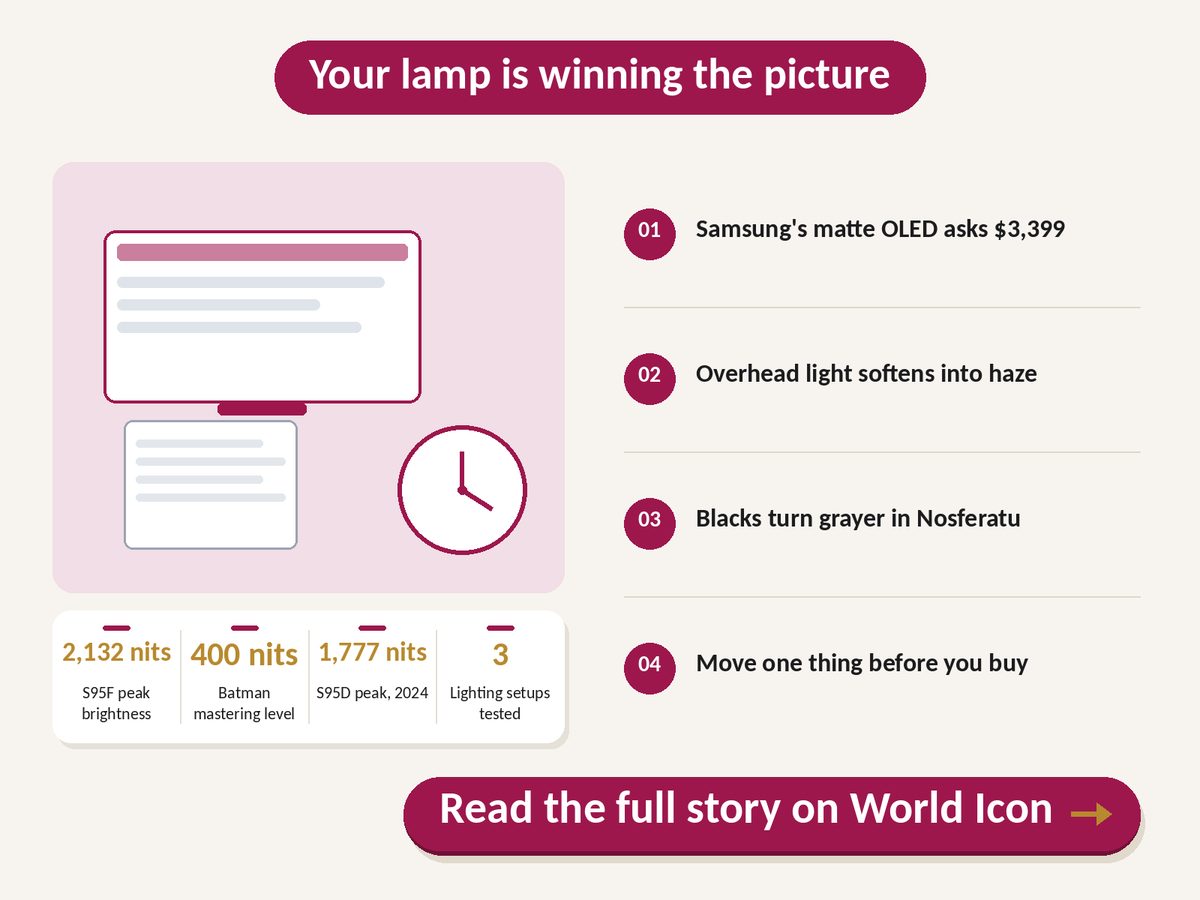
- Matte turned overhead light into haze in TechRadar's June 2025 test, but its blacks read grayer.
- A brighter panel does not cure reflections, so brightness is the wrong first purchase.
- Moving a lamp or closing a curtain costs nothing next to a matte flagship.
- If you watch mostly in a dark room, skip matte and keep the contrast.
Why does TV glare hit dark scenes hardest?
Dark scenes hit hardest because a reflection is added light: a lamp mirrored in the glass sits on top of the picture, and shadows have almost no light of their own to drown it out.
TechRadar's James Davidson tested Samsung's matte Glare Free S95F against LG's glossier, anti-reflection G5 in June 2025 across three lighting setups. The matte panel "eliminated mirror-like reflections" and reduced overhead lights to "a haze". On the G5, room objects reflected on screen and "obscured the picture", leaving Batman near-impossible to see. It fixes lamps. Well, it softens them, which for a sofa facing a window is most of what you want.
The same test shows why brightness will not rescue you. The Batman was mastered at 400 nits (the unit of screen brightness) against the 1,000-nit industry standard for HDR, so the scenes that are hardest to watch in a lit room are dim on purpose. In our judgement, buying a brighter set to beat glare is the outdated advice: the film itself keeps asking for a dim picture.
The number on the box rarely decides what you live with. We said so about why frame rates matter more than 4K for an immersive picture, and about what dialogue enhancement fixes and what it cannot.
Four figures frame the trade. They come from TechRadar's May 2024 and June 2025 Samsung reviews and its Batman test, and together they say whether a bigger panel or a different finish solves your problem.
Samsung Matte Model Years
2 years
Enough history to judge
65-Inch Launch Price
$3,399
Move the lamp first
Peak HDR Brightness
2,132 nits
Plenty, yet lamps still show
Batman Master vs Standard
40%
Dim scenes expose every reflection
Take the brightness reading. It comes from a small 10% white window, the standard way to measure peak output, so it describes a highlight and not the dim scene where a lamp actually bothers you. That mismatch is why a brightness score and a glare complaint rarely describe the same problem.
Brightness never fixed the reflection. A matte finish does, at the price of blacks that read grayer.
Matte vs glossy TV: what do you gain and lose?
You gain a screen that turns lamp and window reflections into a soft haze, and you lose some black depth, so the trade suits lit rooms and punishes dark ones.
The reflection and black rows come from TechRadar's June 2025 test, the peak row from Tom's Guide's April 2024 readings (as of 2024). Tom's Guide reported no reflection measurements, so treat any "no brightness penalty" claim as unproven.
| Dimension | Matte vs glossy | What it means for you |
|---|---|---|
| 💰 Cost to fix | Matte Locked in at purchase Glossy $0 if the lamp moves |
⚠️ Try the free fix first |
| 🌍 Lit room | Matte Overhead light becomes haze Glossy Room objects obscure picture |
✅ Your room stops showing in the picture |
| 🔋 Black depth | Matte Grayer in 2 dark films Glossy Deep, inky blacks |
❌ Costs contrast when the lamps are off |
| 📊 Peak nits | Matte 1,777 nits, S95D (2024) Glossy 1,369 nits, S95C (2024) |
⚠️ Nits alone cannot rate glare |
| ⏱ Best hours | Matte Daylight, lamp-lit evenings Glossy Dark room after sunset |
⚠️ Worth it above 50% lit viewing |
| 🛠 Free fixes | Matte None, the finish is fixed Glossy Curtain and lamp angle |
✅ Test these before you spend |
| 🏁 Best suited for | Matte A sofa facing a window Glossy A dark den, lamps off |
🏁 Choose by where light lands |
Our own rule of thumb, which is reasoning and not a measurement, is that if lit-room hours are under half your viewing, the grayer blacks cost you more than the haze buys.
Four rooms, four verdicts: this settles which lighting situations justify paying for a matte finish and which need only a cheaper fix. The verdicts are our judgement, built on TechRadar's June 2025 three-scene test, not separate measurements.
How do you cut glare without buying a new TV?
Move the light before you replace the screen: shift a lamp out of the screen's mirror angle, close a curtain, or put a dimmer bulb behind the sofa. All three cost almost nothing, so try them first.
Matte is not a free upgrade. TechRadar's April 2025 verdict on the S95F was blunter about what you can see: the anti-glare layer "does still have some impact", and blacks look "a little flat" beside other brands' OLEDs.
Exact figures are still being studied, but early indicators suggest the black-level gap is narrowing: TechRadar's June 2025 S95F review said Samsung's second generation improves on the black crush of the first. Reviews also repeat the spec-versus-use trap we described in why phone battery chemistry beats camera specs: the headline number is rarely the one you live with.
- Matte cannot be switched off, so a mostly dark room pays for relief it rarely uses.
- Blacks read grayer in dark scenes, as the Nosferatu and Wicked comparisons showed.
- Only two 2025 flagships were tested, so do not assume every anti-reflective panel behaves alike.
- Reviews publish brightness, not glare, so ask a retailer to demo the screen under lamplight.
Key Takeaways to act on: check your own room
- A window or lamp you will not move sits in your sightline during evening viewing.
- You have already tried a curtain or a moved lamp and the reflection is still there.
- Lights are on for more than half the hours you actually watch.
- Most of your viewing is not a dark room with the lamps off.
This week, sit where you always sit, play a dark scene with your normal lights on and see what the screen shows. A lamp or curtainable window: fix that and keep the money. A window you cannot cover during the films you really watch: a matte panel is worth the trade.