Monday, August 31, 2026
India's Smart Meters and Peak Hour Tariffs: The Real Cost
- Published
- 8:15 AM
- Author
- Comments
- 0
Nine in the evening in Lucknow. The geyser is on, the AC is running, and somebody has just started the washing machine because the day finally emptied out. On the wall, the box that used to be a spinning disc is now a screen with a clock inside it. That clock is the part nobody explained.
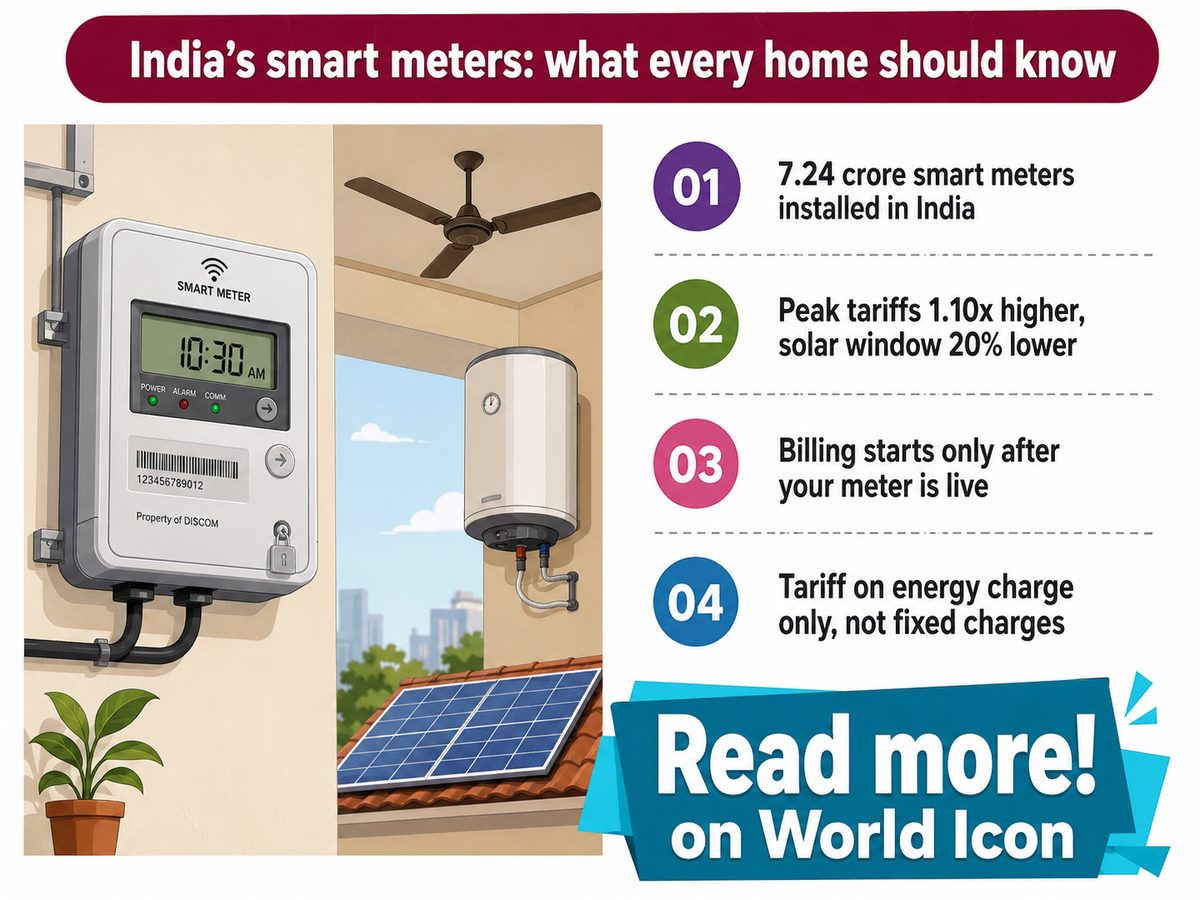
TL;DR: India is replacing electricity meters far faster than it is switching on the pricing those meters enable. Time of day tariffs make evening units dearer and daytime units cheaper, but nothing changes for you until your own meter is commissioned. Count your evening load before the rate reaches you.
Why it matters
The rules arrived long before the hardware. A tariff that charges more for power drawn at the evening peak and less for power drawn while the sun is up needs a meter that knows what time it is, and for most Indian households that meter simply was not on the wall yet. So the policy sat there, notified and unfelt, waiting for an installation crew. That gap between a rule existing and a rule biting is the whole story here.
A written reply in Parliament by Shripad Naik, Minister of State for Power, put the count at 7.24 crore smart meters installed as of 30 June 2026, a count that folds in distribution transformer and feeder meters alongside consumer ones. That is a real number attached to a real date, and it is doing more work than any tariff clause. My view is that the installation figure, not the tariff notification, is the only number worth tracking right now, because a price signal nobody can receive is not a price signal. It is a press release. The interesting question is not whether evening power gets dearer. It is who gets billed that way first, and whether they are told.
Four numbers frame the size of what is still coming, and they matter because each one sets a boundary on how much a household can actually do about its bill. This is the same barrier by barrier arithmetic that decided whether the FASTag Annual Pass was worth buying, moved indoors and onto a wall socket.
Sanctioned
20.33 crore
Meters cleared under RDSS
Domestic peak
1.10x
Minimum peak energy charge
Solar discount
20%
Minimum cut below normal
Solar window
8 hours
Daily cap set by states
The solar window is the one to sit with, because it is the only lever a household actually controls. It is a block of daytime hours your state commission names, and it is capped, so it cannot stretch to cover the hours when a working family is home. Everything a household can save has to be moved into that block: the wash, the pump, the water heating, the charging. If your day is spent away from the house, the discount is aimed at an empty room.
The meter is the trigger, not the notification. Until one is commissioned on your wall, the peak hour price does not exist for you, whatever the rules say.
What the rules actually say
Most of the confusion around this shift comes from mixing up three separate things: the metering programme, the tariff structure, and a set of draft amendments that are still draft. They move on different clocks and they hit different people. Here is the shape of it in one place.
| Category | Detail | Insight |
|---|---|---|
| Rollout | 5.73 crore consumer meters installed under RDSS | Balance came via other grid missions |
| Trigger | Billing changes on the date your meter is commissioned | No commissioning means no peak pricing |
| Non domestic | Commercial and industrial above 10 kW pay 1.20x at peak | Households sit a step below that |
| Scope | Applies to the energy charge, not fixed charges or duty | Savings must come from moved units |
| Rooftop solar | Home systems up to 5 kW stay exempt from net metering charges | Charges scale only above that size |
| Storage | Regulators may require batteries above 500 kW installations | Campuses and IT parks, not homes |
| Your bill | Units split across named peak and solar windows | If absent, your rate has not changed |
Read that table as one sentence and it says the tariff is a discount on when, not on how much. Nothing in it rewards using less power. It rewards using the same power earlier in the day, which is a different behaviour, and a harder one for anyone who works outside the house. The timeline below is the part households should actually diarise.
The timeline tracks the shift from the tariff rules notified in June 2023, through the Ministry of Power draft amendments dated 12 March 2026, to the two proposed compliance dates of April 2027 for large consumers and April 2028 for everyone else outside agriculture.
Friction points
The first problem is that the discount window is a state decision, and states are not obliged to make it easy to find. Your commission names the solar hours, your distribution company prints them somewhere, and between those two steps sits most of the value of this entire scheme. A household cannot shift load into a window it has never been told the boundaries of. This is where the plan quietly fails, not in the tariff maths.
Then there is the reflex that a smart meter means a bigger bill. That reflex is understandable and mostly wrong, and I will argue against it: the meter itself charges nothing extra, and the peak premium for a home is set at the gentler end of the scale. What actually raises bills is the end of estimated readings. A meter that reports honestly, every day, will show consumption that a manual reading used to smooth over, and that correction lands in the same month the new box goes up. Two different things arriving together, blamed on one of them.
Underneath all of it sits a familiar pattern. A rule is notified, the coverage is announced, and then the part that reaches an ordinary person is thinner and slower than the announcement implied. This site watched exactly that happen with India's AI content label mandate after it was notified, and the shape here is the same: strong drafting, uneven delivery, almost no consumer communication at the last mile.
Worth checking before you assume anything about your own bill:
- Look for a commissioning date on the meter or in the last bill, because that date, not any news report, is when your tariff can change.
- Find your state commission's notified solar window and write down its start and end times, since that block is the only place a discount lives.
- Check whether your connection was converted to prepaid mode during installation, which changes how and when you pay rather than what you pay.
- Compare the first two bills after installation against the same months last year, so an honest reading is not mistaken for a peak premium.
Key takeaways to keep
1. The switch is physical. Policy dates tell you when your neighbours might be affected. Only the box on your wall tells you when you are.
2. The discount is aimed at daytime. If the house is empty when power is cheapest, the saving belongs to appliances you can put on a timer, not to habits you can change.
3. The fixed charge does not move. Any saving has to be earned on units you relocate, which caps how much of a bill this can realistically touch.
4. Ask before you argue. A bill that jumps after installation deserves a reading history request first, and a complaint second.
Pull out your most recent electricity bill and look for two things: a commissioning date, and any line that splits units by time of day. If neither is there, none of this has reached you yet and you have time to prepare. If both are there, the next hour worth changing is the one between the geyser and dinner. Move that, and the rest of the argument about smart meters stops mattering to you.
Related: why the LPG eKYC deadline keeps moving and what it means for your subsidy
No comments
Post a Comment