Tuesday, October 6, 2026
Filmmaker Mode Too Dark? Two Settings to Move
Saturday, early afternoon, sun pouring through the window behind the sofa. You put on a film you have waited weeks to see, switch the TV to Filmmaker Mode because every review said to, and the opening scene is a murky smear where a candlelit room should be. Is the panel faulty? It isn't. The phrase people type from the sofa is nearly always filmmaker mode too dark, and the answer starts with the room the mode was built for, which is not yours at two in the afternoon.
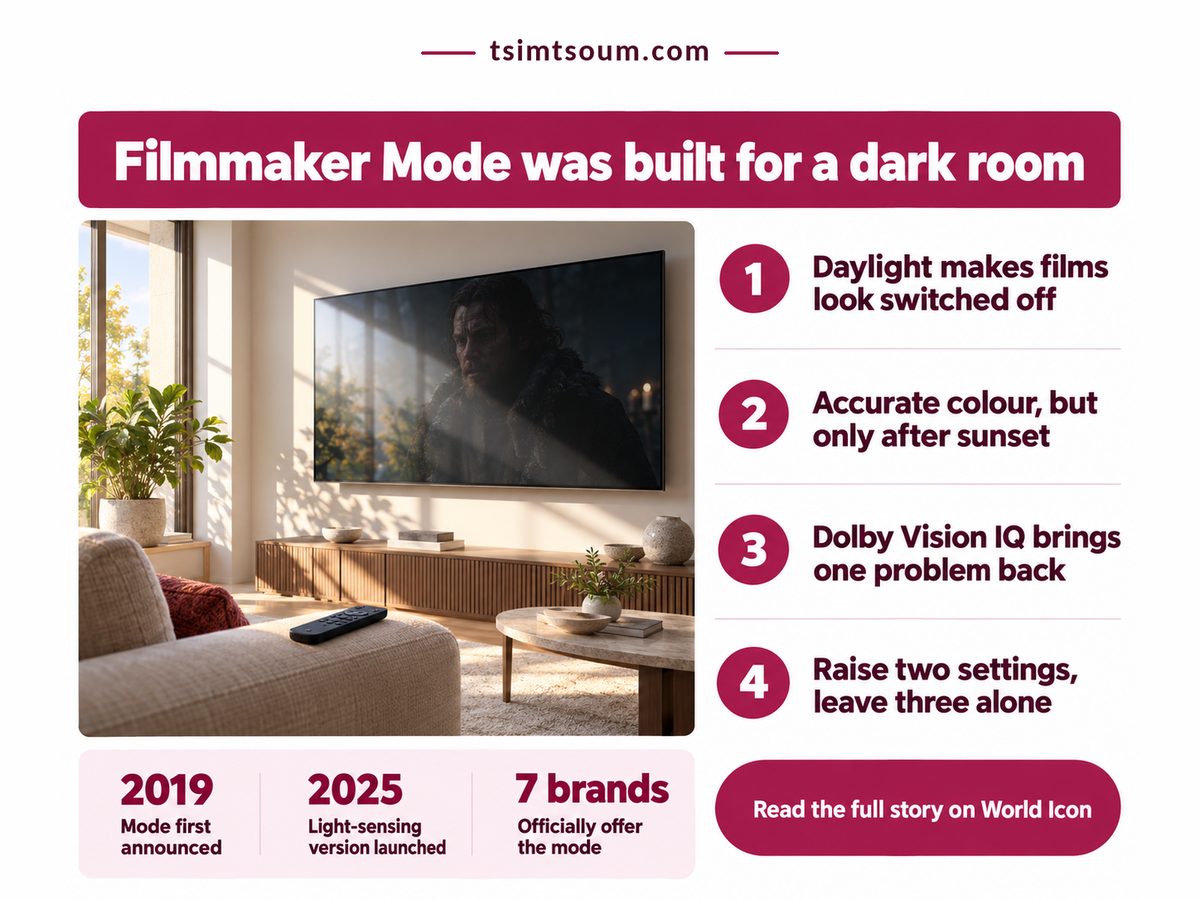
Key Takeaways: Filmmaker Mode is dark by design, tuned for a lamps-off room, and two changes fix daytime viewing.
- Raise panel light (OLED Pixel Brightness or Backlight) first, then lighten gamma one step.
- Leave motion smoothing, sharpening and white point where the mode puts them.
- Never raise the black-level control: it turns black bars grey.
- Undo both after dark, when the stock picture is already correct.
Why is Filmmaker Mode so dark?
Filmmaker Mode is dark because it copies the picture a colorist saw in a dim grading suite, so its brightness and gamma assume a room with almost no light, not a living room at midday.
A UHD Alliance white paper on ambient light compensation, published in October 2025, puts the grading suite's surroundings at 5 candelas per square meter, about the glow of a lamps-off evening, and says compensation should do nothing in a room that dim. Read that as permission: at night the stock mode is already right. The paper also says a fix should leave black level alone and lift only what sits above it, through gamma.
Reviewers hit the same wall. Writing for TechRadar in October 2025, one tester said many films in the mode look "so dark that I might as well have the screen turned off" on a bright day. So nothing needs repairing or returning. The standard advice to always watch in Filmmaker Mode assumed a darkened room, and it has aged badly in homes with big windows.
Four numbers frame the decision, from the mode's timeline, the partner list at FilmmakerMode.com (retrieved October 6, 2026) and the effort a manual fix takes.
Wait for a daylight fix
6 years
Older sets go manual
Cost of the manual fix
$0
No calibrator, no new TV
Brands offering the mode
7 brands
Sony owners use Custom
Menu changes per day
4 changes
If you reset each night
The wait is this article's own arithmetic. Until a version could read the room, every set shipped tuned for darkness, so the manual route is the default answer, not a workaround. If sun lands on the screen itself, that is reflection, and whether a matte TV screen is worth the trade is the better read. Sound has the same problem, covered in what TV and soundbar voice modes can and cannot fix.
Nothing in the panel is broken. The picture is right for a lamps-off room; at two in the afternoon, the room is what's wrong.
Should I use Filmmaker Mode during the day?
Yes, use Filmmaker Mode during the day, but move two settings first: raise the panel's light output and lighten gamma one step, then leave everything else the mode sets exactly where it is.
Panel light comes first: OLED Pixel Brightness on recent LG models, Backlight on most LCD TVs. Push it up until the darkest scene you care about reads from your seat. Gamma comes second, and one step lighter lifts faces while black stays black. The trap is the slider beside it: on several brands, LG among them, Brightness actually sets black level, and raising it greys every letterbox bar.
Which route suits you depends on one fact about your TV.
Filmmaker Mode too dark: fix it by hand or by sensor?
Fix it by hand if your TV was sold before late 2025, because only the newest sets carry the light-sensing version that adjusts Filmmaker Mode for room brightness on its own, and nothing about the manual route costs money.
TechRadar reported in October 2025 that Filmmaker Mode 1.1 adds ambient light compensation through the TV's light sensor while keeping color accurate, and that LG's C5 and G5 OLEDs already ship with it. For those owners, one toggle replaces both manual changes.
| Dimension | Manual vs Sensor | What it means for you |
|---|---|---|
| 💰 Cost to try | Manual Free, works today Sensor Free, late-2025 sets only |
✅ No spend; your TV's age decides |
| 📊 Mid-tone lift | Manual Gamma 2.4 to 2.2 Sensor Rises with room light |
✅ Faces and shadows readable by day |
| ⏱ Daily effort | Manual Undo it at dusk Sensor None once switched on |
⚠️ Easy if you watch at one time of day |
| ⚖️ Black level | Manual Safe unless you touch it Sensor Built to leave it alone |
❌ Grey bars mean the wrong slider moved |
| 🌍 Availability | Manual Every set with the mode Sensor A handful of models |
⚠️ Most owners only have the manual route |
| 🏁 Best suited for | Manual Pre-2025 sets, bright rooms Sensor Newest sets, shifting light |
🏁 Let your TV's model year decide |
The manual route costs a little daily effort; the sensor route costs a newer TV. And if you watch almost only after dark, neither applies.
If your TV went on sale before the October 2025 update, plan on the two manual changes rather than waiting for a sensor to fix daylight dimness for you. Dates come from What Hi-Fi's 2019 launch report and TechRadar's January and October 2025 coverage.
Is Dolby Vision IQ better than Filmmaker Mode in a bright room?
Not usually: Dolby Vision IQ does read room light, but it switches motion smoothing back on by default and can still look drab, so it trades one daytime problem for another.
TechRadar's January 2025 Dolby Vision coverage found the standard Dark and IQ modes apply motion smoothing out of the box. Switch to IQ for brightness and your film starts to look like a daytime soap, so check the motion menu after any mode change.
Some sets offer a better middle path. The same report says Dolby Vision Filmmaker Mode reached LG's 2024 OLED range and Philips' OLED809 in 2024, then TCL's 2025 range, so Dolby Vision titles keep the accurate picture and the same two changes apply inside it. A brighter panel also draws more power, worth knowing if time-of-day tariffs price your peak hours.
- A Vivid or IQ preset brings motion smoothing back.
- Raising black level turns shadows grey.
- Daytime settings left on at night over-brighten a correct picture.
- Sets without the mode need a Custom preset built the same way.
Check these about your own setup first
- Daylight reaches the screen when you actually watch.
- Filmmaker Mode's menu has no light-sensor toggle.
- You know which slider your TV calls Brightness.
- You have a film you know well enough to judge.
This week, pick the sunniest hour you really watch in, play a film you know, and change only panel light and gamma. Grey black bars mean you moved the wrong control.