Sunday, October 25, 2026
TV Electricity Cost: Picture Mode vs Standby
- Published
- 12:16 AM
- Author
- Comments
- 0
The TV is dark, the remote is on the sofa arm, and a small light still glows under the screen. Nobody is watching, yet the set is drawing power. That is the quiet half of your TV electricity cost; the louder half is the picture mode you chose on set-up night. Which is bigger? Two settings decide it.
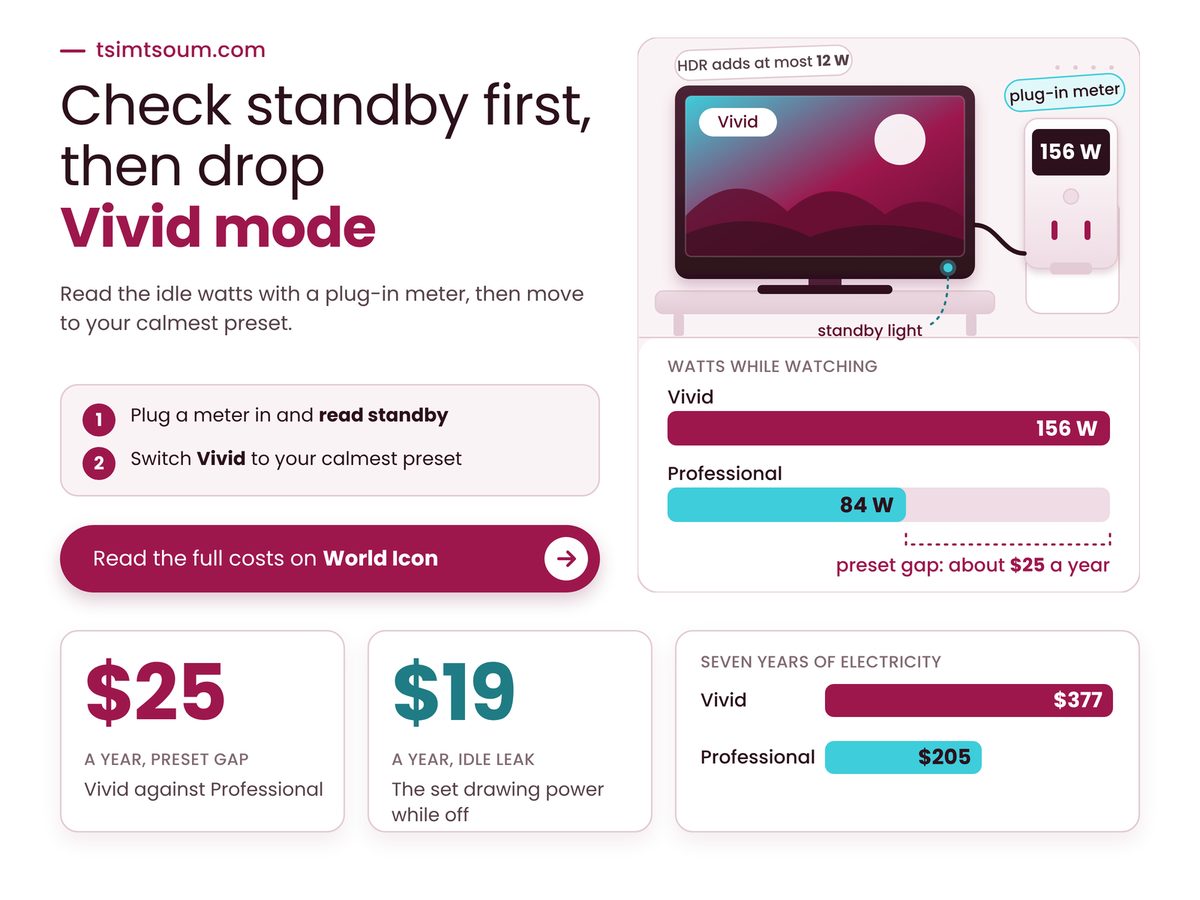
Picture mode and standby each move what a TV costs to run by roughly $20 a year.
- On one 65-inch OLED, the brightest preset drew 156 W against 84 W for the calmest, about $25 a year apart.
- HDR is not the driver: it added at most 12 W on that set, about $4 a year even if every hour were HDR.
- Standby is the check to make: an average non-qualifying set adds about $19 a year, a certified one under $1.
What sets your TV electricity cost each year?
Three numbers set it: the watts your picture mode draws while the screen is lit, the hours you watch, and the standby watts drawn the rest of the day, all priced at your local kWh rate.
Start with the clock. NEEA's April 2026 review (report E26-515) assumes a US set is on 5.2 hours a day and on standby the rest, so even a thin standby draw runs most of the day. Then price: the EIA's October 2026 outlook puts the 2025 US residential average at 17.30 cents per kWh and forecasts 18.21 for 2026. The sum underneath is watts times hours divided by 1,000, times your rate.
The preset is the second lever. In August 2025 What Hi-Fi? put an energy meter on a 65-inch Sony A95L OLED and logged 84 W in Professional, 108 in Cinema, 114 in Standard and 156 in Vivid, all in SDR. It treats Professional as roughly Sony's Filmmaker Mode, the setting our post on fixing a Filmmaker Mode picture that looks too dark covers. One set and one unnamed meter: treat the ratios as a guide. If yours is an OLED, what a five-year OLED burn-in warranty covers is the other long-horizon question.
Four derived numbers frame the decision, built on NEEA's averages (87 W for ENERGY STAR-qualifying 49 to 59 inch sets, 106.9 W for non-qualifying ones), the What Hi-Fi? readings and an 18-cent price.
Standby Time Each Year
6,862 hours
Derived: about 286 days of it
Vivid Over Professional
$24.60 a year
Derived, one OLED, 18 cents
Standby Energy At Market Average
108 kWh
Derived from NEEA's market average
ENERGY STAR On-Mode Saving
19% less
Derived from NEEA's 49 to 59 inch averages
Standby deserves the closer look because it is the only cost you pay while nothing is on. A set kept awake for a voice command or a cast request stays above its certified level, and ENERGY STAR's own criteria draw that line.
Most of a TV's day is standby, so a leaky idle setting can outweigh the gap between neighbouring picture modes.
Does HDR make a TV use more power?
Sometimes, and by little: on the Sony measured, HDR drew 12 W more than SDR in Professional mode, 18 W less in Standard, 12 W less in Cinema and the same 156 W in Vivid.
What Hi-Fi? assumed HDR is 8% of viewing, about 110 of 1,369 hours a year, and admits it is a judgment: Ofcom publishes no split. Even all-HDR viewing in Professional would add roughly $4.10 a year at 18 cents (12 W × 5.2 h × 365 ÷ 1,000 = 22.8 kWh), and in Vivid HDR changed nothing. Switching HDR off to save power targets the smallest lever on the page.
Which TV picture mode uses the least energy?
On the one 65-inch OLED measured, the calmest preset, Professional, used the least and Vivid the most, and the grid below prices each draw at three electricity rates so you can find your own row.
Find your preset's draw on the left, then read across at your price per kWh. Cells are dollars a year at 5.2 hours a day and a certified 0.5 W standby; Pro is Sony's Professional mode.
| Watts | 12¢ | 18¢ | 30¢ |
|---|---|---|---|
| Pro 84 W | $20 | $29 | $49 |
| Cinema 108 W | $25 | $38 | $63 |
| Standard 114 W | $26 | $40 | $66 |
| Vivid 156 W | $36 | $54 | $90 |
The shaded cell, Standard at 18 cents, reads $40 a year. One column right adds $26, one row down adds $14, and one row up saves only $2: the real jump is from the calm presets to Vivid.
Worked example: a 65-inch set in Standard mode at 114 W, on 5.2 hours a day, 0.5 W standby for the other 18.8 hours, at 18 cents per kWh (the EIA forecast, rounded). On-mode: 114 W × 5.2 h = 592.8 Wh a day. Standby: 0.5 W × 18.8 h = 9.4 Wh. Together 602.2 Wh, times 365, is 219.8 kWh a year: $39.56 a year, $276.95 over seven years.
This shows how fast the gap between a calm preset and Vivid builds, so you can judge whether the menu trip pays. Derived from the 84 W and 156 W readings at 5.2 hours, 0.5 W standby and 18 cents.
Does a TV use power when it is turned off?
Yes, a plugged-in TV that looks off still draws standby power, from about half a watt on a certified set to 15.72 W on the market average NEEA reports for non-qualifying sets.
NEEA's Table 4 gives 0.48 W for ENERGY STAR-qualifying sets (California Energy Commission test data). The 15.72 W is an observed market average from an unstated sample size: a warning about the category, not a promise about your set. At 18 cents, that spread is roughly $19 a year, against under a dollar for the certified level.
Our call: Vivid is not an obvious mistake in a sunlit room, or at least not one to sneer at; glare is a real reason to want brightness. Before paying for it nightly, read whether a matte screen is worth the trade.
- Read the label as a ceiling. The ENERGY STAR criteria page we could open (energystar.gov) carries a 30 October 2015 effective date and lists 0.5 W idle and 3 W where an outside signal can wake the set; NEEA cites current v9.1 at 1 W.
- Treat 114 W as a middle. NEEA's fleet average on-mode draw is 124 W as reported, 116 W as calculated, across sizes.
- Measure, then decide. A plug-in energy meter shows watts with the screen dark and again lit.
Key Takeaways to act on: check these on your own set
- Your set wakes for a voice command or a cast request while it looks off.
- Your bill shows more than 25 cents per kWh, about 40% above the calculator's default.
- The preset sits on its brightest setting because of a bright room, not taste.
The decision this week is where to spend ten minutes: standby or picture mode. Plug a meter in behind the TV and read the watts with the screen dark. Above 3 W, hunt the standby setting first; near half a watt, move off Vivid to your calmest preset and stop there. Then put your own wattage and kWh rate into the calculator above.
How we checked this
We read NEEA report E26-515 (26 April 2026), What Hi-Fi?'s Filmmaker Mode energy test (22 August 2025), the EIA Short-Term Energy Outlook (October 2026) and ENERGY STAR televisions criteria page. The worked example assumes a 114 W set, 5.2 hours a day, a 0.5 W standby and 18 cents per kWh. No product was tested hands-on for this article, and the wattages are What Hi-Fi?'s, from one OLED and a meter it does not name. Last verified: 25 October 2026. Edited by Ragu, reviewed after publication. Spotted something out of date? Tell us and we will correct it.
No comments
Post a Comment